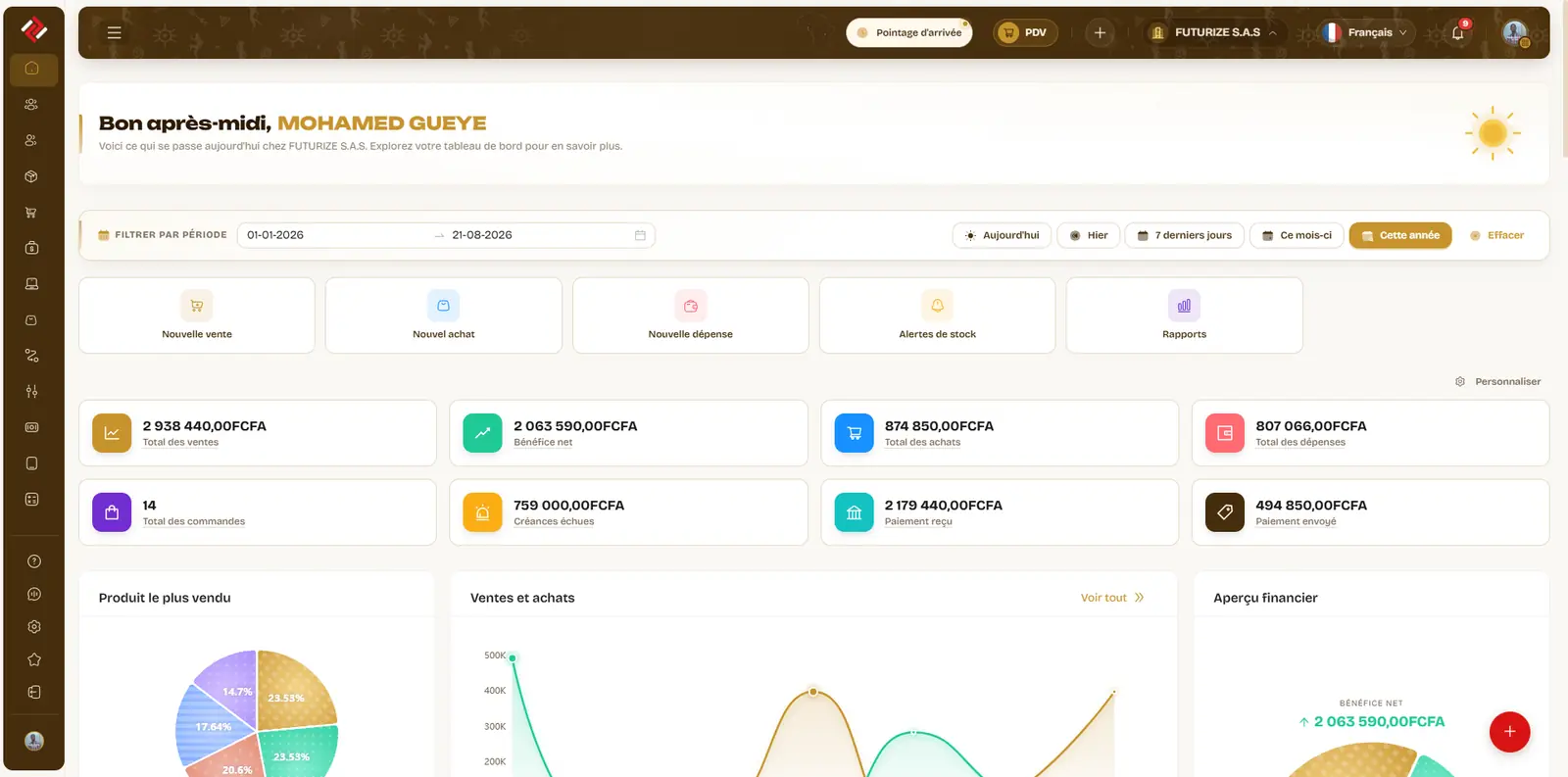
The same record serves the counter, the purchase order and the online storefront.
Sizes, colours, capacities: one record, several variations, each with its own stock and price.
A barcode generated or taken from the packaging, and a sheet of labels ready to print.
What you can do with it
A structure that serves search at the counter as much as grouping in the reports.
Variation axes per product, with stock and price of their own per combination.
A GTIN-style item code for scanning, and an internal SKU for your own logic.
Both live on the record, which makes margin calculable without a spreadsheet.
Whatever your trade needs and nobody else asks for, added to the record.
The catalogue goes in and out as Excel or CSV, with a template and a check before committing.
How it works
-
01
Import or type
An Excel file for an existing catalogue, direct entry for a few dozen items.
-
02
Organise and vary
Brands, categories and variants, so search at the counter stays fast.
-
03
Print the labels
A sheet per format, and the shelf becomes scannable.
What the module includes
- Products
- Brands
- Categories
The units people actually sell
A lot of goods arrive in bulk and sell by the unit: the 50 kg rice sack, the carton of 24 sachets, the pack broken down for retail. The product record carries the purchase unit and the selling unit, which avoids keeping two items for the same goods. And imported products often arrive with their own barcode: it is reused as is rather than generating a second one.
Common questions
Does every product need a barcode?
No. A product is also found by search. The barcode speeds up the counter: generate one for what you sell often, and reuse the packaging’s own for imported goods.
What is the difference between item code and SKU?
The item code is a GTIN — it scans and it is unique. The internal SKU is your own naming logic. Both live on the record and each stays unique in its own right.
Can I set prices per customer?
The selling price lives on the product and can be overridden line by line at sale or quote time. There is not yet an automatic per-customer price list.